 Svenesis.org
5 August 2026 · 🔭 Astronomy
A Falcon 9 Upper Stage Hits the Moon – and I Film Absolutely Nothing
At 08:35 CEST this morning, a spent upper stage of a SpaceX Falcon 9 struck the Moon. I recorded it live with my rig in Texas – from a holiday house in Denmark, with a coffee in my hand. The grown-up children were still in bed, my wife was out walking, breakfast was not until eleven. It is hard to imagine better conditions for a remote observing session in Texas.
The result first: you see nothing. At least I got to grips with SharpCap along the way.
The tip came from Hannover
The event was not on my radar at all. Robert, a fellow stargazer from the Volkssternwarte Hannover astronomy club, pointed it out to me a few days ago – adding that I of all people could observe it: in Germany the impact fell in the bright morning, whereas in Texas it fell at 01:35 in the middle of the night. So there was nothing to be done from here – but plenty from Texas.
A pleasant side effect: no alarm clock, no setting up in the dark. Even the day before I could practise in comfort – well rested, coffee in hand – while the stars had long been out over Texas. And I did need the practice.
What actually hit
The object has no name, only the catalogue number 2025-010D. It is the upper stage of the Falcon 9 that sent the lunar landers Blue Ghost and Hakuto-R on their way in January 2025, and it has been drifting in a wide Earth orbit ever since – 26 days per revolution, 220,000 to 510,000 km out. That orbit crosses the Moon's. Usually one of them is somewhere else when the other passes through the intersection. Not today.
The key figures:
- Mass: about 4,900 kg, roughly as tall as a five-storey building
- Impact speed: 2.43 km/s – just under 8,700 km/h
- Energy: 14.5 billion joules, equivalent to about three tonnes of TNT
- Impact site: 19.5° N, 93.3° W, near the crater Einstein – right on the western limb of the Moon
- Expected crater: about 17 m across
The prediction came from Bill Gray of Project Pluto, from 1,053 observations by asteroid surveys and amateurs. At lunar distance the military's radar simply fails – the echo is 25 billion times weaker than for near-Earth objects. Orbits like these are only known to those who observe optically, that is, with telescopes like mine.
And the largest uncertainty is not gravity but sunlight: radiation pressure pushes the tumbling piece of metal measurably sideways over the course of months.
Why you see nothing
Bill Gray was cautious from the outset, and I had read as much. I wanted to try anyway.
The reason for the scepticism is the speed. Natural meteorite impacts on the Moon regularly produce flashes of light – but those arrive at 10 to 70 km/s. Our upper stage was travelling at a comparatively leisurely 2.43 km/s, and the slower the impact, the smaller the share of the energy released as visible light. The rest goes into heat and into shovelling lunar rock aside.
The second hope was the dust plume. The impact point lies almost exactly on the limb of the Moon, in sunlight – material thrown high enough could rise clear of the edge and become visible against the black background. Gray's own back-of-the-envelope estimate: at an ejection speed of around 100 m/s, a chunk climbs for a minute and gets three kilometres up. Seen from Earth, though, three kilometres at the lunar limb is all of 1.5 arcseconds – at my image scale of 2.03 ″/px, less than a single pixel.
There is a precedent: in 2009 NASA deliberately crashed a rocket stage into the Moon with LCROSS, carefully timed and watched by large telescopes. Nothing was seen.
The real reason I did this
I could have spared myself the whole thing. The fact that I did not has a side effect worth more to me than any dust plume: I had to get to grips with SharpCap.
Up to now everything here has run through N.I.N.A. – sequences, autofocus, filter wheel, meridian flip. I only took the rig over recently and am still working my way in; one piece of software was quite enough to begin with. For deep-sky work N.I.N.A. is exactly right anyway. For the Moon and the planets it is not, and for a fundamental reason: N.I.N.A. is a sequencer for long individual exposures. What is needed here is lucky imaging – thousands of very short frames in rapid succession, from which the few sharpest are picked out and stacked afterwards. That is precisely what N.I.N.A. is not built for: no video mode, no high frame rates, no SER recording.
SharpCap is built for it. And as it always goes when you pick up a new tool for the first time: an entire morning disappeared into trying things out.
My settings
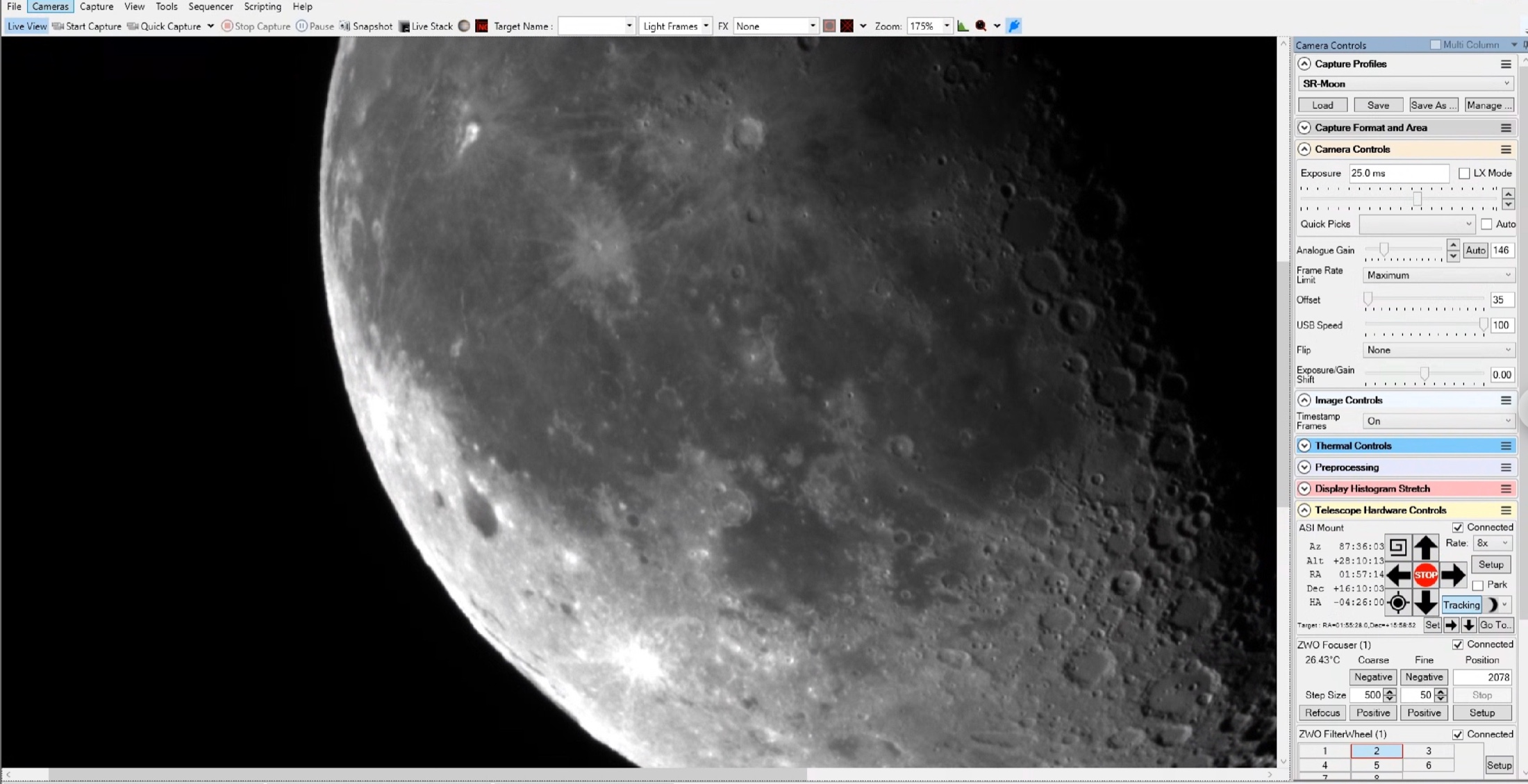
After plenty of experimenting – and a fair bit of back and forth with Claude AI, my sparring partner – I ended up with this configuration:
| Setting | Value |
|---|---|
| Camera | Ares-M Pro (IMX533, mono) |
| Filter | red |
| ROI / crop | 1504 × 1504 |
| Bit depth | Mono16 |
| Format | SER |
| Analogue gain | 176 |
| Offset | 35 |
| Exposure | 25.0 ms |
| Frame rate | 38.15 fps |
| Timestamp frames | on |
The thinking behind it:
Cropping to 1504 × 1504. The IMX533 has 3008 × 3008 pixels – the full field is pointless for the lunar limb and only costs frame rate. A quarter of the area is plenty and still generous.
Red filter. Two reasons. Long-wavelength light is jostled less by the atmosphere, so the seeing is noticeably calmer in the red. And atmospheric dispersion – the smearing of the image into a tiny spectrum – disappears within a narrow band. For the Moon and the planets a red filter is the standard choice, not a compromise.
25 ms. Short enough to half-freeze the seeing, long enough for a clean signal. On paper that would allow 40 fps; in reality it comes to 38.15, with the rest going on readout and transfer.
SER rather than AVI. SER is an uncompressed raw format created specifically for astronomy. It handles 16 bits, has no codec artefacts, and writes a timestamp for every single frame – not entirely unimportant for an event predicted to the second.
And what that means in data
1504 × 1504 pixels × 2 bytes makes 4.52 MB per frame, and at 38.15 frames per second that is 173 MB/s, or 10.4 GB per minute. That is the price of Mono16 without compression – and the reason why, with lucky imaging, you think carefully about when you press record.
Three SER files ended up on the disk, named after their start times in Texas:
| File | Start | Length | Frames | Size |
|---|---|---|---|---|
01_34_45.ser | 01:34:45 | 10.1 min | 23,068 | 104.4 GB |
01_45_39.ser | 01:45:39 | 5.1 min | 11,578 | 52.4 GB |
01_51_34.ser | 01:51:34 | 5.0 min | 11,451 | 51.8 GB |
| Total | 20.1 min | 46,097 | 208.5 GB |
The split was deliberate: the impact was predicted for 01:35:37, and the first recording starts 52 seconds before it and runs on for nine minutes afterwards. That is exactly what Gray advises – do not switch off shortly after the appointed time, because a dust plume needs time to rise clear of the limb. The two five-minute clips continue the watch.
A good 200 gigabytes for twenty minutes. Downloading it from Texas takes longer than the recording did – and I am still weighing up whether to simply delete it. Nothing happened, after all.
And then: nothing
SharpCap was running on the laptop, and on the phone next to it the YouTube livestream from Starfront Observatories – the very observatory where my own rig stands. A countdown, a host cam, and a fisheye camera looking across the telescope field.
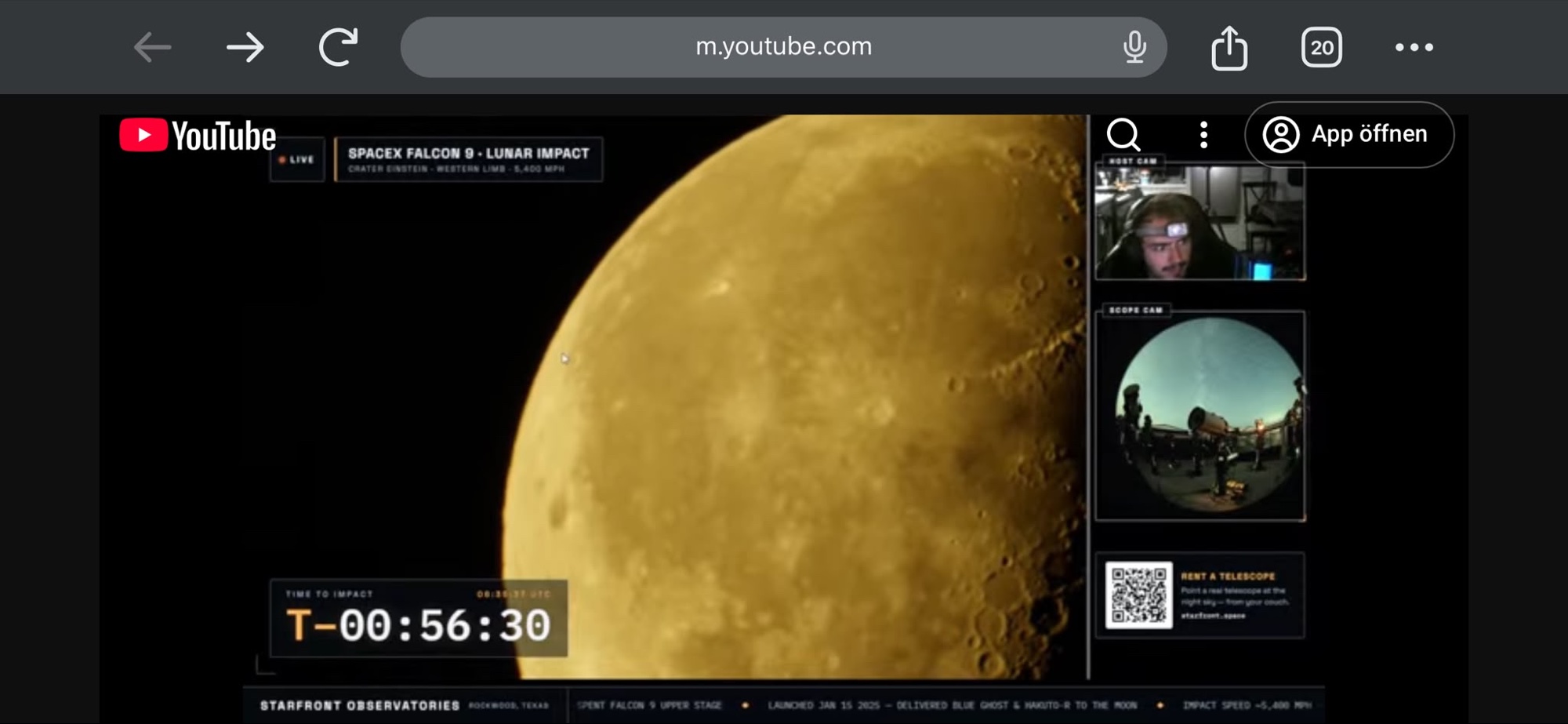
No flash, no plume, no point of light that had not been there before. Exactly what Gray had predicted, and exactly the outcome LCROSS had already produced.
That is part of it. A negative result is a result, and for an event whose visibility was considered unlikely from the start, it is even the expected one. It is still disappointing – I had been quietly hoping.
There will be pictures of the crater, incidentally, only later and not from me: back in 2022 the Lunar Reconnaissance Orbiter photographed the double crater left by the Chinese Chang'e 5-T1 upper stage, and Gray fully expects the LRO team to take a deliberate look at the predicted spot this time too.
Added 19 August 2026: the crater has been photographed. The Lunar Reconnaissance Orbiter imaged the site on 11 August, six days after the impact – frame M1541091337R, together with a before image of the same spot (M1370003265R) and an oblique view.
What it shows:
- Crater: 18 m across, less than 3 m deep – about 17 m had been expected
- Position: 19.4759° N, 266.7138° E, which is 93.2862° West. Gray’s prediction of 19.5° N / 93.3° W is therefore less than a kilometre off
- Ejecta: one-sided towards the south, mixed dark and bright – the dark streaks come from the surface regolith, the brighter material from deeper layers
Which settles the sentence above: the LRO team did take a deliberate look at the predicted spot. In the end the impact was seen by an orbiter from lunar orbit – and by no telescope from Earth. The images at LROC
What is left
A video with no event in it – and a tool I can now operate. SharpCap runs, the configuration stands, and I know the data volumes. That clears the way for something I have not touched at all with this rig: the Moon and the planets. For deep-sky work N.I.N.A. keeps its sequences; for anything that needs many frames per second there is now a second piece of software on the machine.
Which leaves my thanks to Robert in Hannover. Without his tip I would have missed the whole thing – and would have kept putting SharpCap off.
And it was a good occasion, incidentally, to take in what actually happened here: 4.9 tonnes of metal, adrift between the Earth and the Moon for a year and a half, hit a point that was calculated to within a few kilometres months in advance – by one individual, from observations by five observatories and a handful of amateurs. That is more impressive than any dust plume.
Sources
Bill Gray, Project Pluto: Upper stage impacting the moon on 2026 August 5
Project Pluto: Observations and orbit determination for 2025-010D
LROC / Arizona State University: Falcon 9 Impact Analysis – the LRO images of the crater from 11 August 2026
Fernando, Heldmann, Gray et al.: Observational planning for the 2026 August 5 Falcon 9 Upper Stage lunar impact (arXiv:2607.14625, July 2026)
🔭 The rig behind it: My rig @ Starfront in Texas · Why one pixel is the limit here: Over- and undersampling → · The camera behind it: From photon to number →