 Svenesis.org
Observing Planner
Which planets stand where during a night, how bright is the moon, which constellations are up – and which galaxies, nebulae and star clusters are most worthwhile at the chosen location? Everything is computed in your browser. Only when you zoom into the star map does it fetch sky photographs from CDS, Strasbourg; this can be switched off. Whether the night will be clear is shown by Astro Weather.
Constellations
The best objects of the night
Events of the night
How to read the observing planner
Location and night: choose a location and the date of the evening; the arrows step one night on. All times are local time; for custom coordinates in the zone chosen next to them under “Time zone” (preset to your browser’s).
Moon
Phase, lit share and age since new moon at the time set on the slider, plus its place in the sky, rise and set between sunset and sunrise, the moon-free astronomical darkness, distance and apparent diameter, and the next new and full moons. “Show moon calendar” opens a month below it with the phase and lit share of every night and the times of the principal phases; clicking a day chooses that night.
Constellations
The sky as you see it in front of you: horizon and compass points at the bottom, a green cross for the zenith near the top. It looks south; drag, the arrows or the arrow keys turn the view. Dashed yellow is the ecliptic, pale blue the Milky Way, the curved lines mark 30° and 60° altitude. Names can be hidden or switched between Latin and English. The bars under the map show when the moon and planets are above the horizon – the stronger, the higher; clicking them sets the time. On the right: the altitude at the chosen time (now), the highest altitude in the night while the sun is at least 6° below the horizon (max alt) and the brightness, for the moon its lit share. Zoom: with +/−, a double-click, Ctrl/⌘ + scroll wheel or two fingers; zoomed in, the map can also be dragged up and down. The closer the view, the fainter the stars (down to magnitude 8), the more star names and Greek letters, plus the catalogue’s galaxies, nebulae and star clusters as symbols – clicking a star, a planet, the moon or an object opens a card below the map with rise and set, brightness, distance, constellation and coordinates (for objects in the list with “Show on star map”). “Grid” shows the coordinate grid (J2000), “Boundaries” the IAU constellation boundaries. The map shows the sky as it appears: with the stars’ proper motion up to the chosen night and lifted by the refraction of the air, about half a degree at the horizon. From 45° wide, the map also shows sky photographs of the Digitized Sky Survey, fetched from CDS, Strasbourg; “Sky photos” switches them off.
The best objects of the night
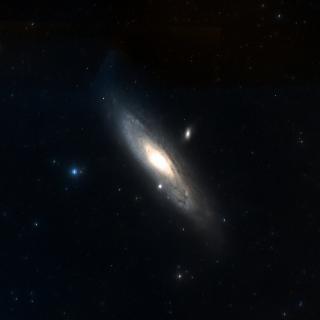
The 15 most worthwhile of 168 galaxies, nebulae and star clusters that climb at least 20° in darkness. For imaging counts time high up, moon and size, for the eye brightness, surface brightness, altitude and moon. The order only compares the objects of that night. “Show on star map” marks the object on the star map and shows its altitude through the night right below it – clicking the chart sets the time, “Clear pick” ends it; picture and chart in the list grow under the mouse. In the chart: green is astronomical darkness, the red area the moon, the violet line the meridian flip, the dot the best time.
Events of the night
Passes of the ISS, Tiangong and Hubble, close encounters of the moon, planets and bright stars, active meteor showers with their peak rate (ZHR – you usually see fewer) and comets brighter than about magnitude 12. Each kind has its own table; “Show on star map” sets the time and the star map to the event.
Terms in brief
- Astronomically dark: the sun more than 18° below the horizon.
- Brightness (mag): the smaller the number, the brighter; the naked eye reaches about +6.
- Surface brightness: how concentrated the light is – extended objects are harder to see.
- Size: diameter in arcminutes (′); the full moon measures about 30′.
- Meridian flip: at its highest the object crosses the north–south line, and a German equatorial mount has to flip.
- Object types: galaxies are distant islands of stars, emission nebulae glowing gas, reflection nebulae lit dust, dark nebulae obscuring dust, planetary nebulae the shells of dying stars; globular clusters are dense, open clusters loose groups of stars.
Where the values come from
Sun, moon and planets are calculated by your browser. The moon follows the main orbital perturbations after Meeus and agrees with the U.S. Naval Observatory on rise and set to about a minute. The planets come from JPL’s (NASA) orbital elements, their brightness from the model by Mallama and Hilton (2018); both were checked against the Horizons ephemeris service: positions agree to better than a tenth of a degree, brightness to about a tenth of a magnitude.
The object catalogue holds every Messier object except M40 (a double star) and M73 (a small group of stars), plus well-known NGC and IC objects, including southern ones such as Omega Centauri and Centaurus A. The coordinates come from the SIMBAD astronomical database in Strasbourg; brightness and size are rounded guide values.
The scores of the list are a weighting of my own from these data, and so is classing a location as near a city. The weather does not feed in – whether the night will be clear is shown by Astro Weather.
Stars and constellations come from d3-celestial by Olaf Frohn: stars down to magnitude 8 (those fainter than 6 are loaded from this server only when you zoom in) from XHIP, a compilation of data from the Hipparcos satellite, constellation lines and name positions after the charts of the International Astronomical Union (IAU), and the Milky Way outlines from the Milky Way Outline Catalog by Jose R. Vieira. Spot checks of the star positions agree with SIMBAD.
The thumbnails in the list are cut-outs of the Digitized Sky Survey (DSS2, colour version), a survey of the whole sky on photographic plates from the Schmidt telescopes on Palomar Mountain and in Australia. They were made once with the hips2fits service of CDS in Strasbourg and are stored on this server – nothing is loaded from other servers when you visit the page. The Wikipedia links load nothing until they are clicked.
Satellites and comets: the orbital data of the ISS, Tiangong and Hubble (NORAD two-line elements) come from CelesTrak, their intrinsic brightness from Heavens-Above. Your browser computes the orbits with the SGP4 method after Vallado and others (2006); the results agree with its test cases and with JPL’s Horizons ephemeris service. The comet orbits come from JPL’s Small-Body Database. Both data sets are refreshed before the site is uploaded and are stored on this server; pass predictions hold for about two weeks. The meteor showers follow the calendar of the International Meteor Organization.
Coordinates, sizes and position angles: SIMBAD database, operated at CDS, Strasbourg, France · Planetary orbits: JPL (NASA) · Planetary magnitudes: Mallama & Hilton (2018) · Stars and constellations: d3-celestial by Olaf Frohn (BSD licence) with star data from XHIP/Hipparcos (ESA) and the IAU constellation boundaries · Proper motions and parallaxes: Hipparcos new reduction (van Leeuwen 2007) via VizieR (CDS) and Milky Way outlines by Jose R. Vieira · Thumbnails: Digitized Sky Survey, produced at the Space Telescope Science Institute under U.S. Government grant NAG W-2166 from plates of the Oschin Schmidt Telescope (Palomar) and the UK Schmidt Telescope, © Caltech, AAO, PPARC and AURA; cut-outs with hips2fits (CDS) · Sky photographs in the star map: DSS colored as HiPS from CDS (CNRS/Université de Strasbourg), fetched live from alasky.cds.unistra.fr · Satellite orbits: CelesTrak (NORAD), magnitudes: Heavens-Above · Comet orbits: JPL Small-Body Database · Meteor showers: International Meteor Organization. Scores and location classes are derived from these.