 Svenesis.org
My Rig @ Starfront in Texas
Starfront Observatories – the Official Video
My astrophotography rig is hosted remotely at Starfront Observatories in Texas, USA – on a Lite Pier in Building 8, under some of the darkest skies reachable by a hosted setup. The place is Rockwood near Brady in Central Texas, the geographic “Heart of Texas”: 430 metres up, with no city close enough for its light dome to reach. How dark it actually is I have since measured myself – and because the site is listed as an observatory in its own right by the Minor Planet Center, the coordinates are official too. Both are below the video.
An impression of the site – the official video from Starfront Observatories:
Site data
| MPC code | V57 – listed as an observatory in its own right by the Minor Planet Center: “Starfront Observatories, Rockwood” |
| Position | 31° 32′ 49.6″ N, 99° 22′ 56.1″ W (MPC notation: 31.547099° N, 260.61774° east longitude) |
| Elevation | 431.9 m above sea level (1,417 ft) |
| Parallax constants | ρ cos φ′ = 0.853050 · ρ sin φ′ = +0.520209 – the MPC uses them to reduce submitted measurements to the geocentre |
| Time zone | US Central – CST (UTC−6) in winter, CDT (UTC−5) in summer |
| Time difference | 7 hours behind Germany – except for two to three weeks in March and in late October, when the US and the EU switch to summer time on different dates; then it is 6 |
| Sky brightness | SQM ≈ 21.9 mag/arcsec² → Bortle 2 – measured myself, worked back from 0.68 e⁻/px/s in the luminance filter (derivation) |
| Clear nights | 220–250 per year (operator’s figure) |
The original MPC line: V57 260.61774 0.853050 +0.520209 Starfront Observatories, Rockwood. Starfront themselves advertise Bortle 1 – my measurement lands just below that, within its own uncertainty of about two tenths of a magnitude.
🌤️ What the weather there looks like for the coming nights: Astro weather for Starfront →
I operate the rig entirely from Germany: sequencing, guiding, focusing, and power control all run remotely, and the raw data finds its way home automatically.
📖 How did this rig become mine? The whole story – a used turnkey rig already sitting under Texas skies, bought from my sofa via Discord, and everything you inherit when you take over someone else's system: 8,500 Kilometers to a Better Sky →
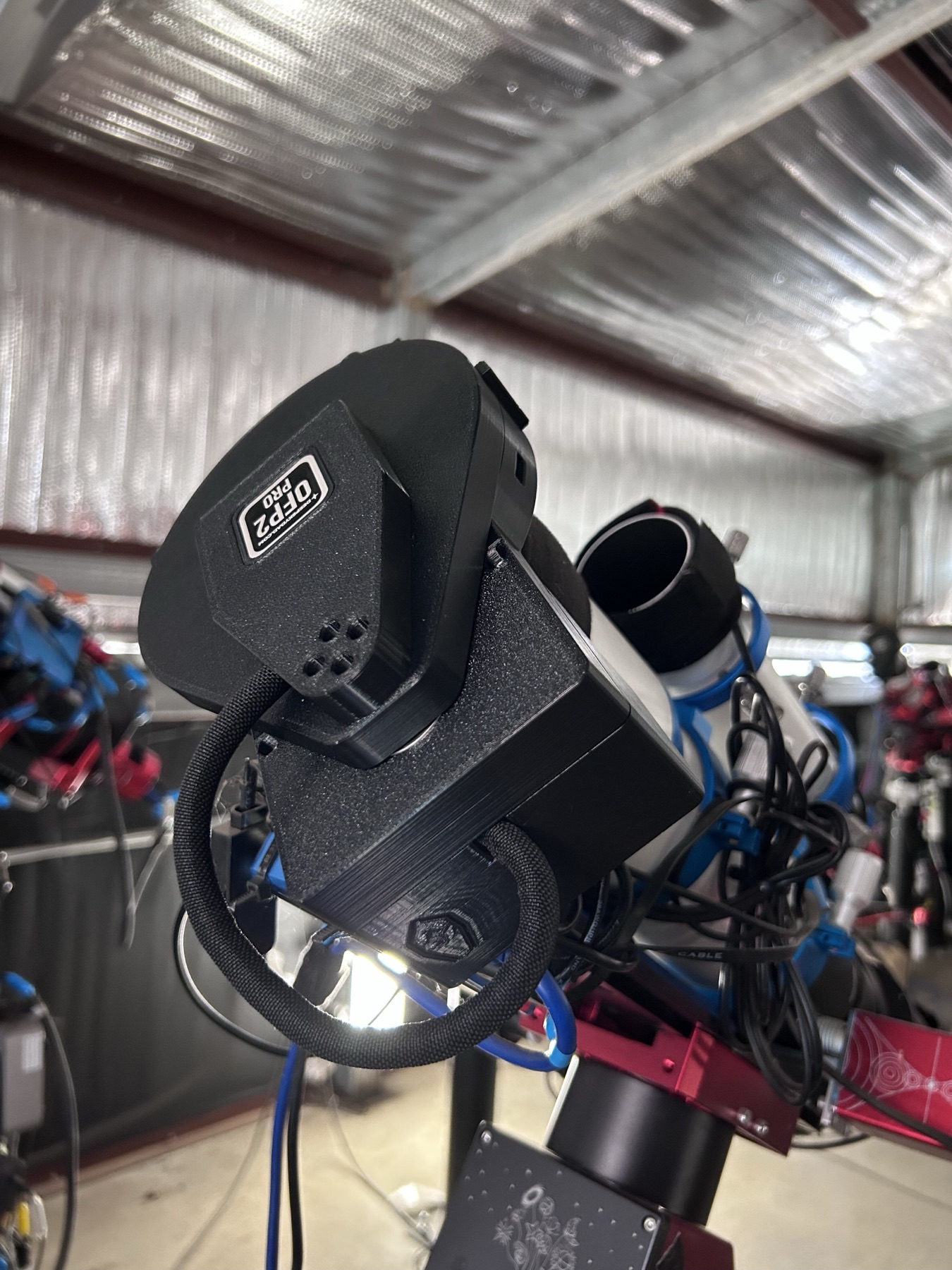
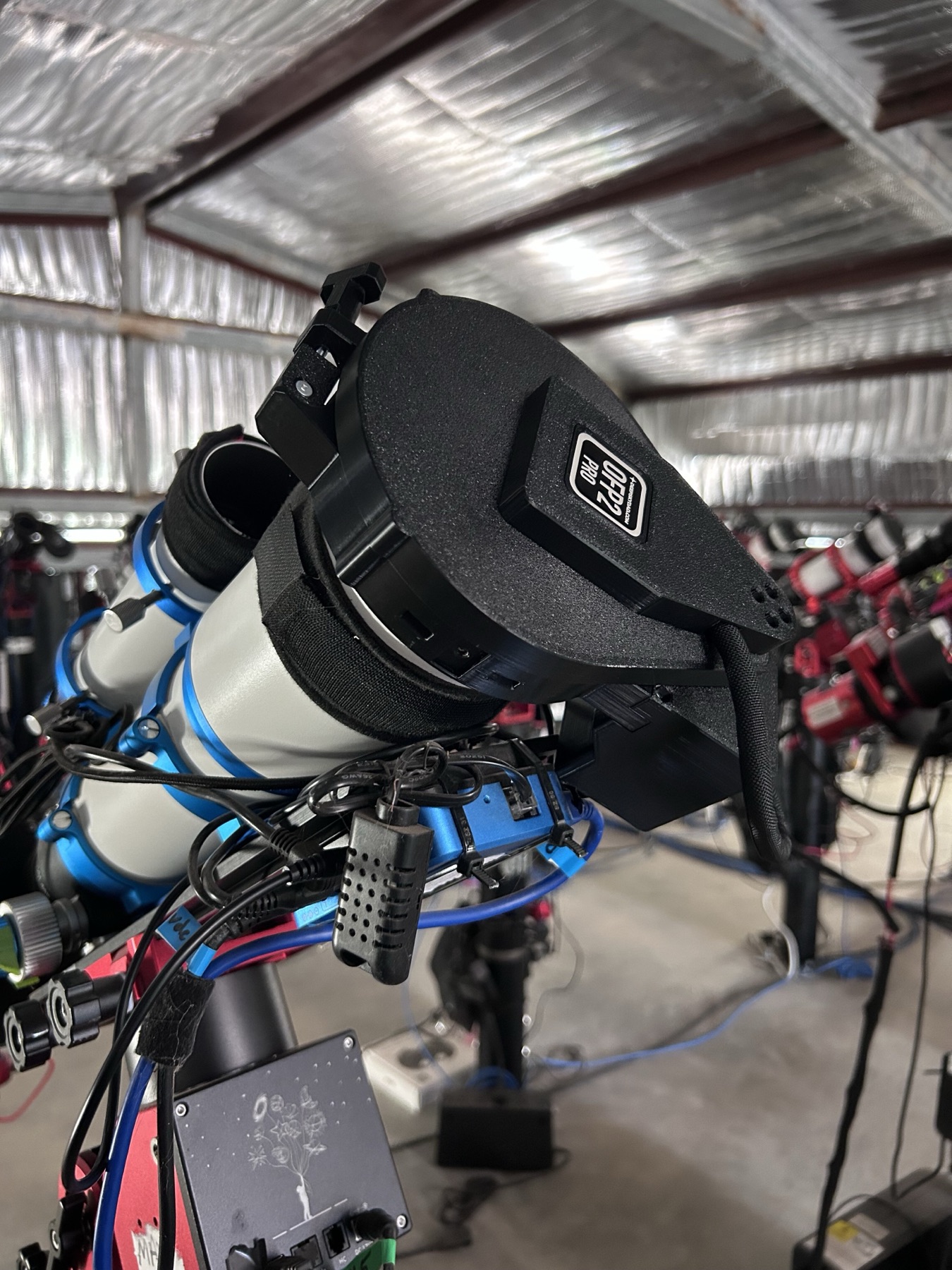
💡 New since 10 August 2026: a motorised flat panel on the front of the dew shield. It lets the rig calibrate itself at the end of every night. A lid that lights up →
The Rig at a Glance
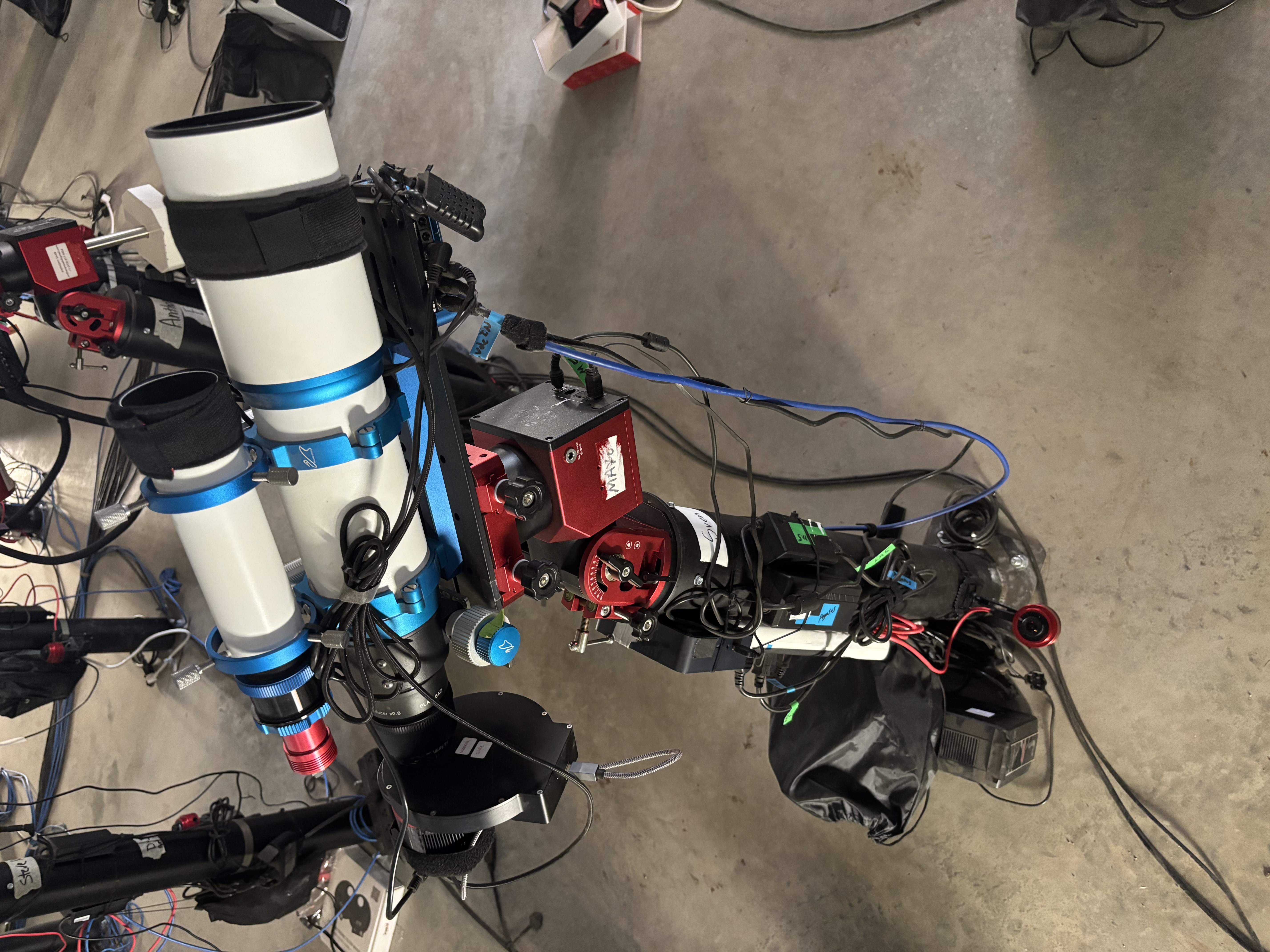
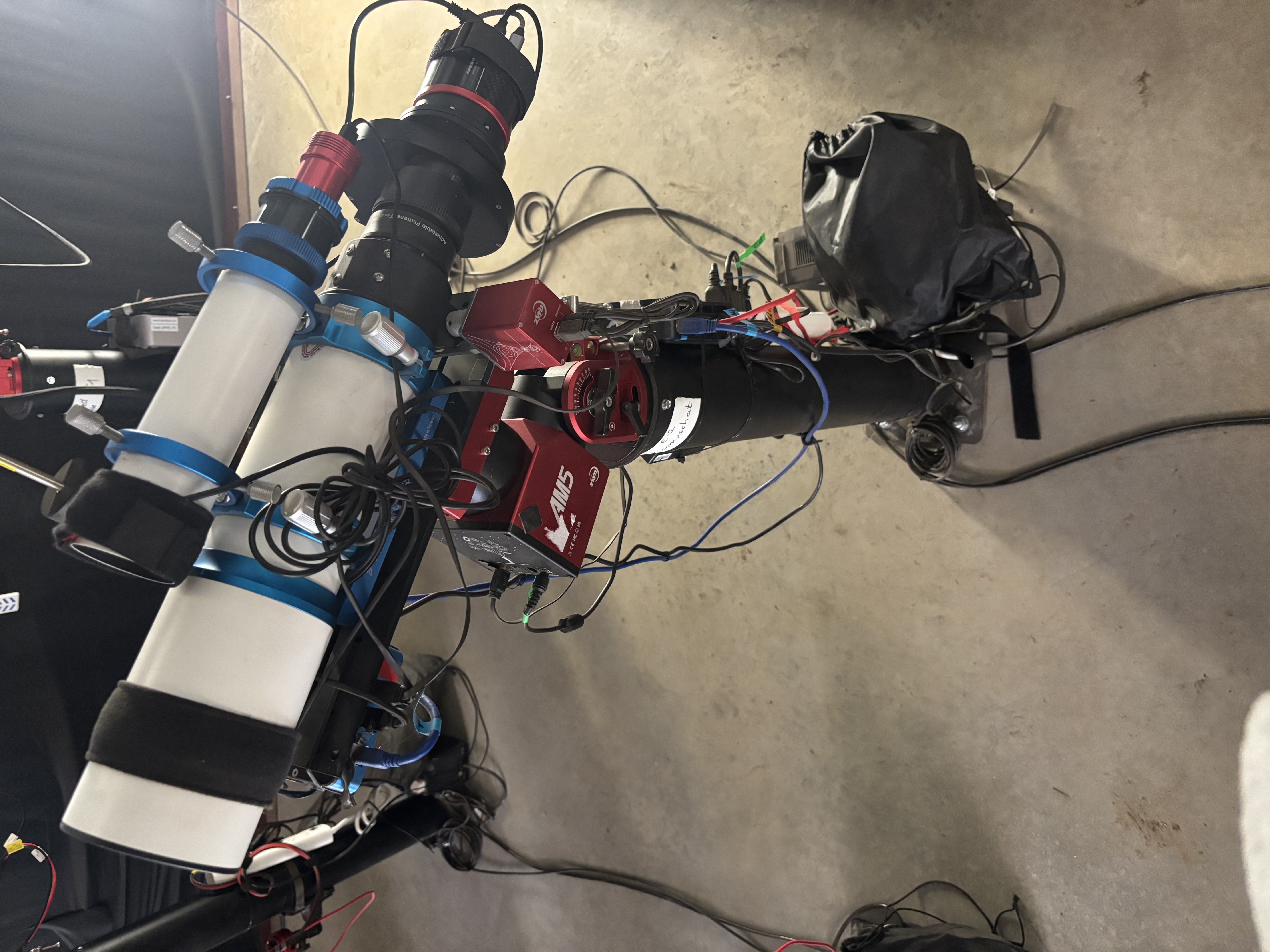
- Telescope: William Optics GT81 – 81 mm f/5.9 FPL-53 triplet apochromat, 478 mm focal length
- Reducer/Flattener: WO FLAT6AIII 0.8× → 382.4 mm at f/4.72
- Mount: ZWO AM5 harmonic-drive mount on a fixed pier (no counterweight, ≈ 7.3 kg of 13 kg payload)
- Main camera: Player One Ares-M Pro – IMX533 mono, 3008² px, 3.76 µm – image scale 2.03″/px, FOV 1.69° × 1.69°
- Filter wheel: ZWO EFW 8× 1.25″ – seven Antlia filters, all 1.25″ mounted with 2 mm glass (parfocal – one spacer stack, no reshimming):
- Narrowband – Antlia 4.5 nm Edge: H-alpha (Hα, 656 nm), OIII (oxygen, 500 nm), SII (sulphur, 672 nm)
- Broadband – Antlia LRGB V-Pro: L (luminance), R (red), G (green), B (blue)
- Focuser: ZWO EAF on the GT81's 2.5″ rack & pinion focuser
- Guiding: WO 50 mm f/4 guide scope + ASI290MM Mini – 2.99″/px, ~1.5× the imaging scale
- Dew control: Dew Not heater straps on both dew shields, auto-driven by a temperature/humidity probe
- Flat panel: Deep Sky Dad OFP2 PRO on the 103 mm dew shield of the GT81 – motorised cover that swings aside, 12-bit brightness in 4096 steps, heated; shut, it doubles as dust cover and light block (article about it)
- Rig PC: Beelink EQ14 mini-PC (Windows 11) on a VESA pier mount
- Pier cam: ZWO ASI662 (IMX662, 1920×1080) – fixed to the pier, watching rig and roof
- Power hub: Pegasus Pocket Powerbox Advance Gen2 + APC Back-UPS + Kasa HS300 smart strip
Mechanical Stack & Optical Train
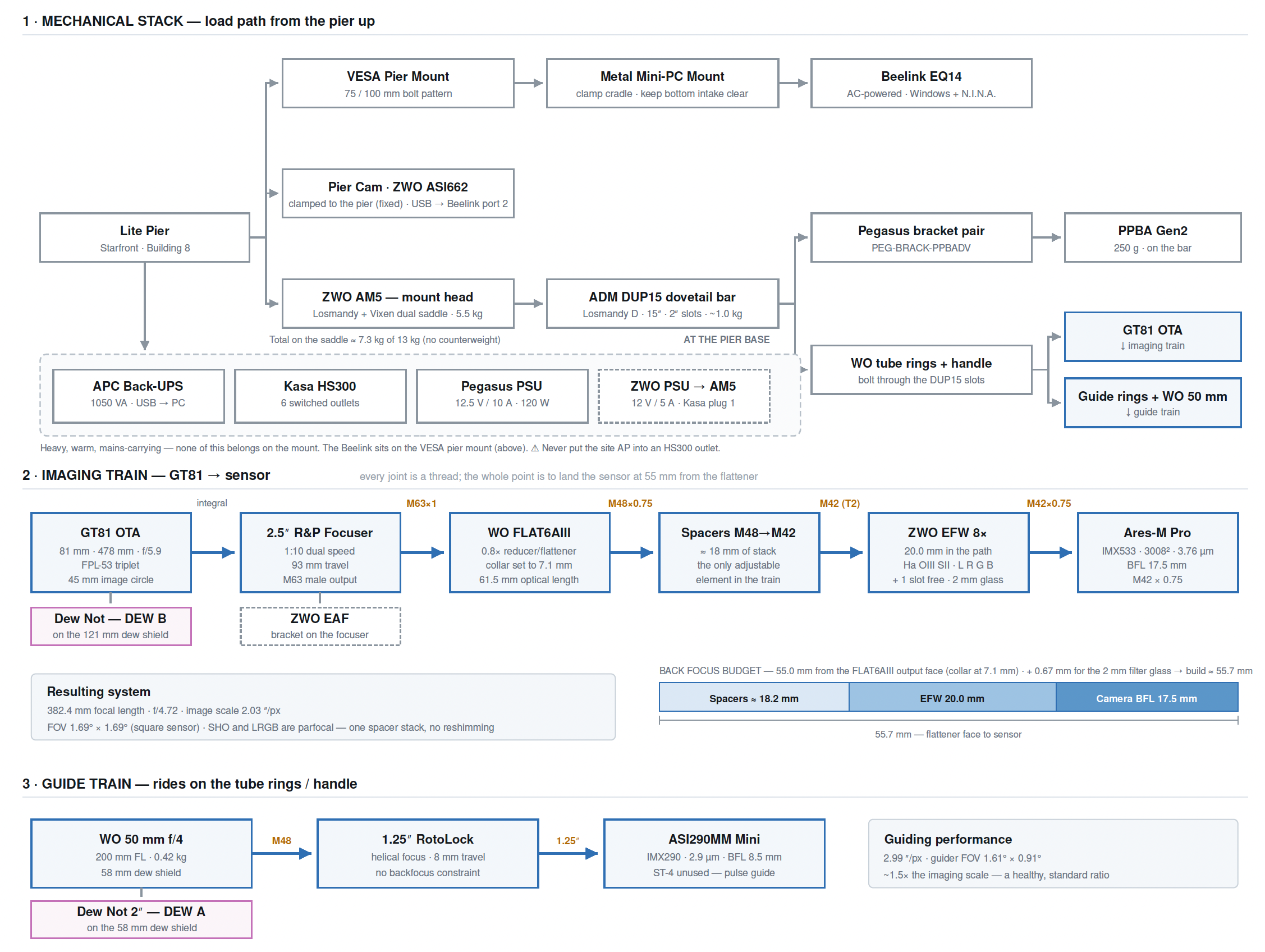
The full load path from the pier up, the imaging train from the GT81 to the sensor (with the complete back-focus budget of 55.7 mm from flattener face to sensor), and the guide train riding on the tube rings:
Power, USB & Network Topology
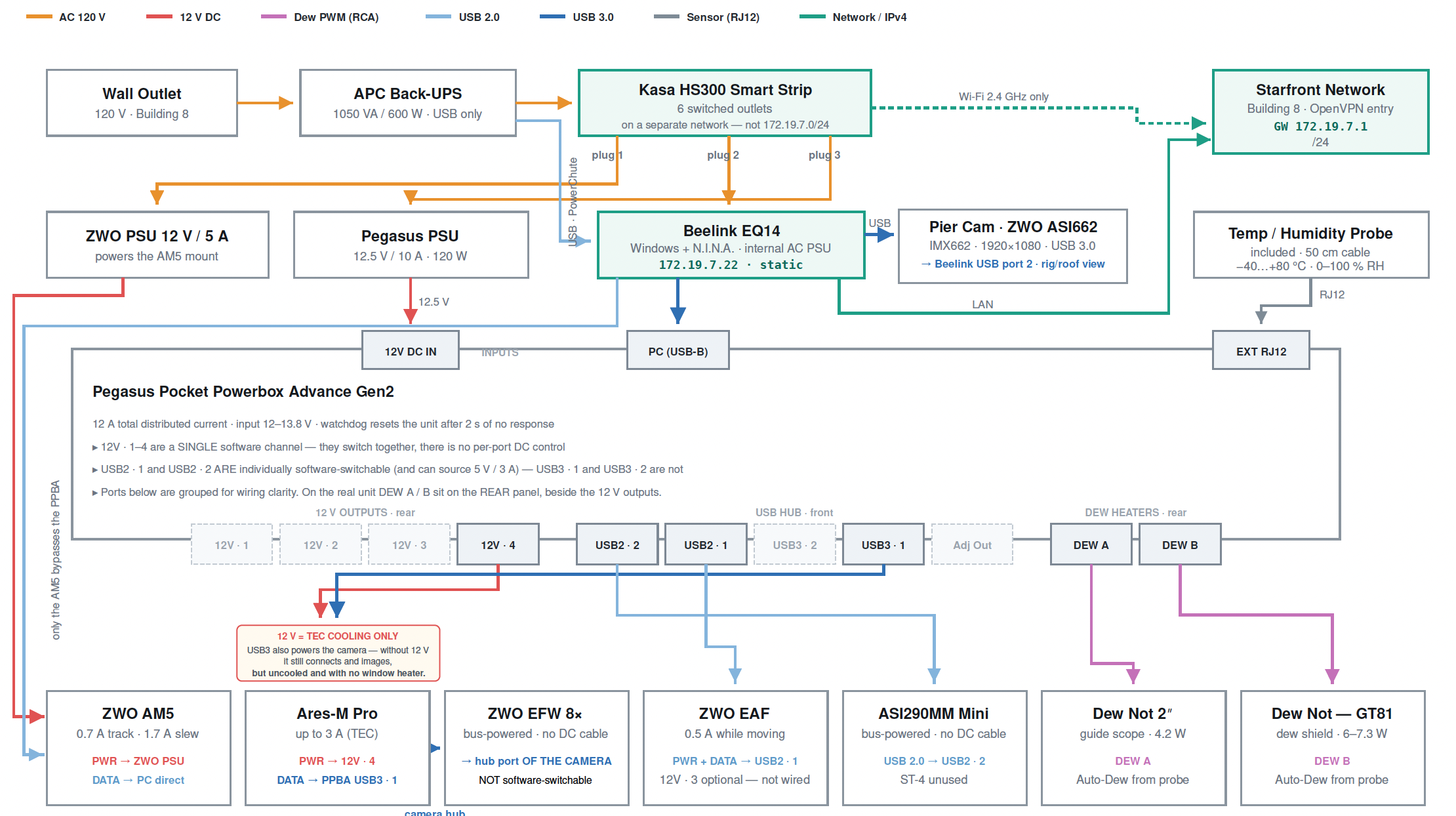
Wall power runs through an APC UPS into the Kasa HS300 smart strip; the Pegasus PPBA Gen2 distributes 12 V and USB on the mount and drives the dew heaters from its temperature/humidity probe. The Beelink sits on the Starfront network with a static IP, and a pier cam (ZWO ASI662) keeps an eye on rig and roof:
Software Stack
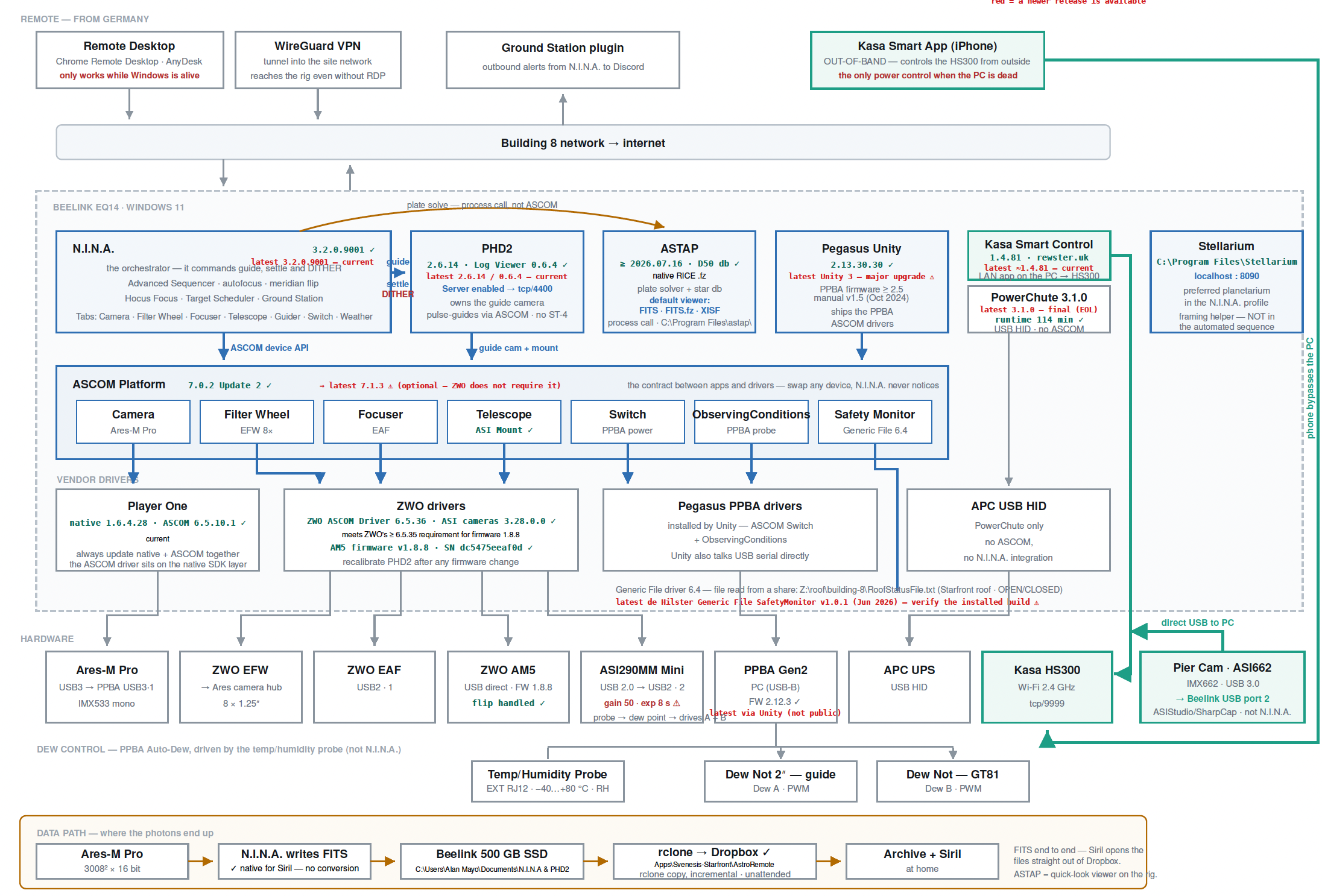
N.I.N.A. is the orchestrator – Advanced Sequencer, autofocus, meridian flip, and the Ground Station plugin for outbound alerts to Discord. PHD2 handles guiding, ASTAP plate-solving, and Pegasus Unity the power box. Everything talks through the ASCOM platform, so any device can be swapped without N.I.N.A. noticing. Remote access from Germany runs over a WireGuard VPN and remote desktop; the Kasa smart strip provides out-of-band power control – the only way in when the PC itself is down.
Data Path
N.I.N.A. writes FITS to the Beelink's SSD; rclone copies them incrementally and unattended to Dropbox. At home in Germany, Siril opens the files straight out of Dropbox – no manual transfer at any point.
A Night at Starfront
Timelapse from the pier cam: