 Svenesis.org
July 28, 2026 · 🔭 Astronomy
Dithering – why I deliberately shake my telescope
It sounds contradictory: you spend nights building a setup so that the guiding lets nothing wobble – and then you shift the telescope by a few pixels between frames on purpose.
That is dithering, and it is one of the most effective tools in astrophotography. Here, briefly, is why.
The principle
Between two individual frames (subs) the mount moves by a small, random offset of a few pixels. The trick lies in how two kinds of signal respond to that:
- The sky signal – nebula and stars – is brought back into register during stacking, because the software aligns the frames on the stars.
- Sensor artefacts stick to their pixel position and do not travel along with that alignment.
Sensor artefacts means three things: hot pixels, which always read too bright, cold pixels, which stay too dark, and fixed pattern noise – the chip's own, always identical structure, because no pixel amplifies quite like its neighbour or produces exactly the same dark current. What all three have in common: they belong to the sensor, not to the sky. Where the telescope points is irrelevant to them.
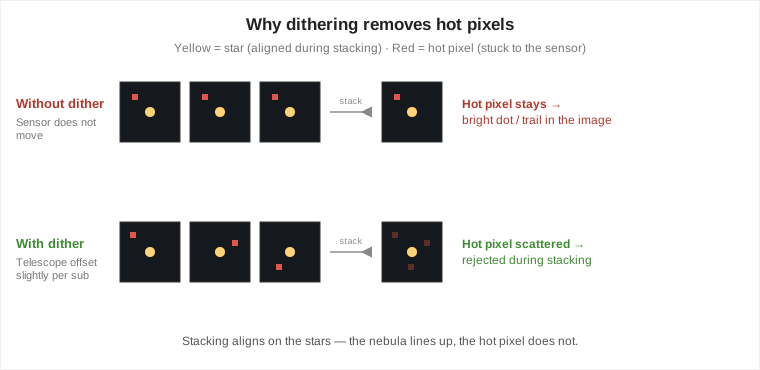
Without dithering a hot pixel sits at the same spot in every sub and stacks into a fixed bright dot.
With dithering it lands somewhere else in every sub – and stacking with statistical outlier rejection (kappa-sigma) simply throws it out, precisely because it isn't in the same place everywhere.
The worst case it prevents
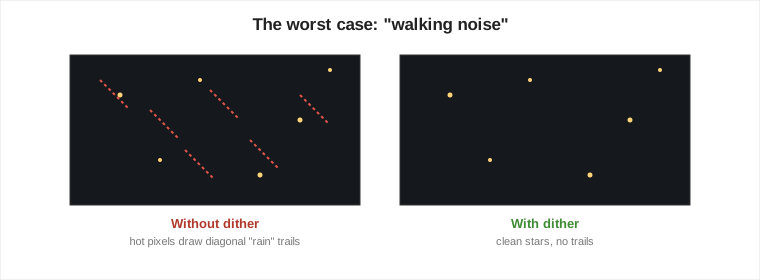
If the guiding drifts very slightly and steadily, individual hot pixels turn into diagonal "rain" or "worm" trails running right across the finished image. This is called walking noise, and it is extremely stubborn – almost impossible to remove once it is in there.
"But doesn't guiding prevent exactly that kind of drift?" No – and this is where most people get stuck. Guiding irons out the fast errors: periodic worm error, gusts of wind, load shifts. It keeps the stars round.
What it does not reliably prevent is a slow, one-directional creep of a fraction of a pixel per frame. That comes from residual polar misalignment, from differential flexure between guide scope and main optics – or simply from the guide camera not noticing, at its own scale, what amounts to a tenth of a pixel on the big sensor.
And then comes the uncomfortable part: if guiding were perfect and the drift exactly zero, that would be the worst case for hot pixels. Every one of them would land on precisely the same pixel in every sub and stack into a fixed bright dot.
Walking noise lives in between, in slow one-directional movement. Good guiding therefore only shifts the problem between dot and trail. The only thing that removes it is movement that is random rather than one-directional – and that is dithering. It breaks the correlation that creates those trails.
How I set it up
In practice N.I.N.A. and PHD2 work together: after a sub, N.I.N.A. shifts the lock position, PHD2 re-acquires, and only once the guiding has settled does the next exposure start. My values:
- Dither: on, every sub. With 300-second exposures the settle pause costs only a few percent – easily worth it.
- How far? The value is given in guide camera pixels but acts on the main camera – and the two image scales are rarely the same. The rule of thumb from the N.I.N.A. documentation: pick a number of guide-camera pixels that shifts the main camera's image by about ten pixels. With typical combinations that lands at roughly five.
- Both axes (not just RA). My AM5 has no Dec backlash, so I dither in both directions and decouple things better.
- Settle: quiet within 1.5 px for at least 10 seconds, otherwise it waits.
Why it matters particularly for me
Against hot pixels on the main camera there are really three tools: darks (which subtract them during calibration – though not completely, or the next item wouldn't be needed), cosmetic correction (which hunts down the survivors and replaces them with the average of their neighbouring pixels) and dithering. At the moment I only use the third – so dithering is effectively my only active defence.
Frequently confused: the "bad-pixel map" in PHD2 belongs to the guide camera and only helps the guiding not to lock onto a hot pixel – it has nothing to do with your finished images. The equivalent for the main camera is called cosmetic correction and lives in processing (in Siril or PixInsight, say), not in N.I.N.A.
My camera's sensor is very clean and shows no amp glow – but every chip has hot pixels, and long narrowband subs collect them. Without dither I see them as dots and trails; with dither they are gone.
One prerequisite only: it needs enough subs and a stacking routine that registers on the stars and rejects outliers. Kappa-sigma starts working from about ten frames and becomes properly reliable beyond twenty – below that, other methods are the better choice, and which one fits depends purely on the frame count. That decision is one my stacking script takes off my hands.
Registering and rejecting is what I do on every run anyway. So: tick the box – and statistics does the rest.
🔭 More about the rig: My Rig @ Starfront in Texas · How I got the guiding under control: A Lost Guide Star in PHD2 → · What else threatens the optics: Dew on the Telescope →